
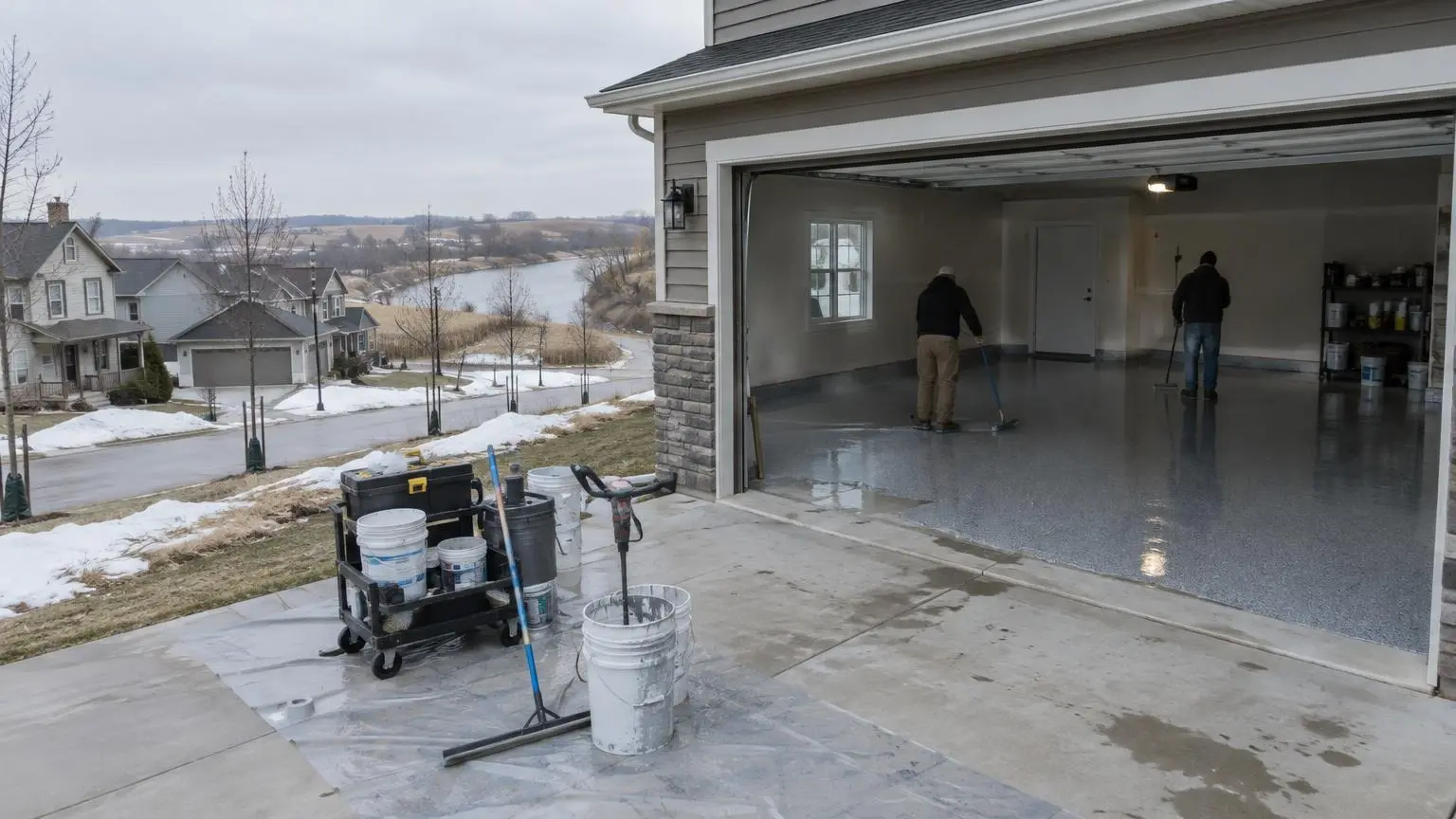
Concrete coatings for Linn County and the Corridor
Epoxy Flooring in Cedar Rapids, IA
Garage, basement and shop floors prepared for Iowa winters, humid summers and slabs of every age.
- Free on-site estimate with a slab moisture test
- Itemized written quote that names every coat
- Concrete diamond ground and repaired before coating
Coated Concrete That Holds Up in Eastern Iowa
Epoxy flooring in Cedar Rapids has to handle a wide swing of conditions on the same slab. Wikipedia's climate figures for the city put the average January high at 27.9°F and the average low at 11.3°F, with July averaging 82.8°F by day. The Eastern Iowa Airport records about 26.7 inches of snow a year, and the city hit -30°F on January 31, 2019. A garage floor here sits through months of freezing slush and salty meltwater, then a humid summer. The coating has to stay bonded through all of it, which means the work under the coating matters as much as the coating itself.
A city of mixed-age concrete
Cedar Rapids has housing from every decade. American Community Survey data for 2019 to 2023, as summarized by Point2Homes, shows that 14.3% of the city's homes were built in 1939 or earlier, and the median year built is 1974. Neighborhoods close to downtown such as Wellington Heights and Oakhill Jackson have many older houses with detached garages and thin, patched slabs. Northern neighborhoods and newer subdivisions have attached two- and three-stall garages with flatter, sounder concrete. Before we quote, we look for old paint and sealers that have to come off, cracks and settled sections, and low spots where water pools.
The river and the basement
On June 13, 2008, the Cedar River crested at 31.12 feet in Cedar Rapids, far above the old record of 20 feet. Wikipedia reports that 1,126 city blocks flooded and about 5,900 homes were evacuated. Many basements and garages in the flooded area were cleaned, repaired or rebuilt afterward. A basement slab that has been under water, or that sits on damp ground, can push moisture up into a coating and make it blister. That is why every basement estimate starts with a moisture test. If the slab is damp, we use a moisture-tolerant primer or tell you the water source needs to be fixed first.
Radon is common here
Iowa HHS states that Iowa has the largest share of homes above the EPA action level of 4 pCi/L, at 71.6%, and that the EPA lists the entire state as Zone 1. Coating a basement floor does not replace a radon mitigation system. If you are finishing a basement, test for radon before the floor goes in so any mitigation work, such as a suction point through the slab, is done first.
Floors that work hard
Wikipedia notes that grain processing directly supports about 4,000 jobs in Cedar Rapids, that the city is one of the largest corn-processing centers in the world, and that Collins Aerospace is the largest employer. A lot of people here work around production floors, and a lot of homeowners run their garage like a shop. Workbenches, rolling tool chests, floor jacks and spilled fluids all wear on a finish. For those floors we use thicker systems and harder topcoats, and we add texture where boots and wet tires meet the floor.
The systems we install
- Epoxy base with a polyaspartic or urethane topcoat: strong adhesion to ground concrete, with a topcoat that resists scratches and UV.
- Flake broadcast floors: colored vinyl chips spread into the base coat, which hide dust and salt residue and add grip.
- Polyaspartic systems: fast-curing coatings that can go down in a single day and handle cooler shoulder-season temperatures.
- Metallic epoxy: a poured, swirled finish for finished basements, rec rooms and dealerships.
- Shop and commercial floors: heavier 100% solids systems for carts, lifts and chemical exposure.
What the job includes
- A walk-through to agree on what gets moved and where
- A moisture test and a written note of cracks, spalls and old coatings
- Diamond grinding across the full floor and along the walls, with dust collection
- Crack and spall repair, with control joints filled or kept open as you prefer
- Base coat, color or flake layer, and a clear topcoat
- Written cure times and winter care instructions for your specific floor
Where We Work
Our base is Cedar Rapids, and we cover Linn, Johnson, Benton and Jones counties. That includes Marion, Hiawatha, Robins, Palo, Fairfax, Ely, Center Point, Springville, Mount Vernon and Lisbon in Linn County; Iowa City, Coralville, North Liberty, Tiffin and Solon in Johnson County; Vinton, Atkins and Shellsburg in Benton County; and Anamosa and Monticello in Jones County. The floors change a lot across that area. Marion's median home was built in 1994 and North Liberty's in 2004, so many slabs there are newer and need less repair. Iowa City and the older parts of Cedar Rapids have more pre-war houses with detached garages and aged concrete. River towns such as Palo and Vinton have a flood history that shows up in basement moisture. Each town page covers what we know about local floors.
- Epoxy Flooring in Cedar Rapids, IA
- Epoxy Flooring in Marion, IA
- Epoxy Flooring in Hiawatha, IA
- Epoxy Flooring in Robins, IA
- Epoxy Flooring in Palo, IA
- Epoxy Flooring in Fairfax, IA
- Epoxy Flooring in Ely, IA
- Epoxy Flooring in Mount Vernon, IA
- Epoxy Flooring in Lisbon, IA
- Epoxy Flooring in Center Point, IA
- Epoxy Flooring in Springville, IA
- Epoxy Flooring in Iowa City, IA
- Epoxy Flooring in Coralville, IA
- Epoxy Flooring in North Liberty, IA
- Epoxy Flooring in Tiffin, IA
- Epoxy Flooring in Solon, IA
- Epoxy Flooring in Vinton, IA
- Epoxy Flooring in Atkins, IA
- Epoxy Flooring in Shellsburg, IA
- Epoxy Flooring in Anamosa, IA
- Epoxy Flooring in Monticello, IA
Our Epoxy Flooring Services
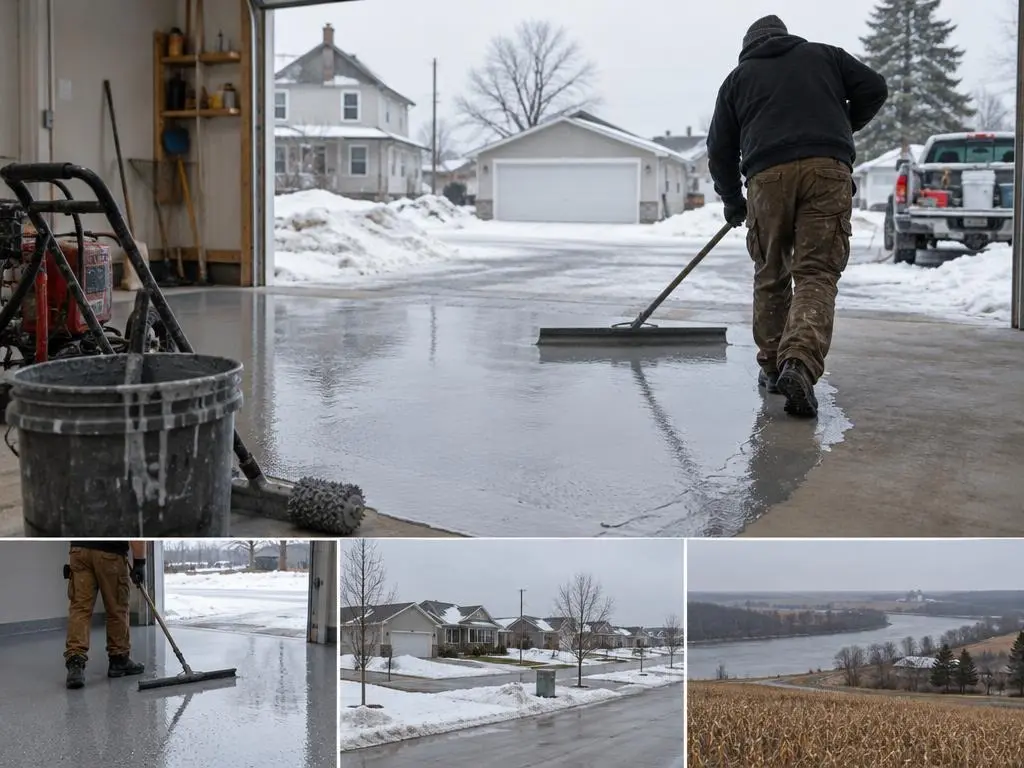
Six coating services for the garages, basements and work floors found from Marion to Iowa City.
Garage Floor Coating
Ground, repaired and sealed garage slabs that keep winter brine on the surface and clean up with a squeegee.
Learn more →Epoxy Flake Floors
Full-broadcast chip floors with texture and color blends that hide dust, salt film and everyday wear.
Learn more →Polyaspartic Floor Coating
Fast-curing, UV-stable coatings that can often go down in one day and handle cooler install temperatures.
Learn more →Basement Floor Epoxy
Moisture-tested basement coatings for laundry rooms, rec rooms and storage areas, with radon and flood history in mind.
Learn more →Metallic Epoxy Floors
Poured, swirled metallic finishes for basements, rec rooms, home bars and dealerships.
Learn more →Shop & Commercial Floor Epoxy
Heavy-duty coatings for home shops, pole buildings, warehouses and commercial floors that take rolling loads and spills.
Learn more →Common Questions
How much does epoxy flooring cost in Cedar Rapids?
HomeGuide's national range for professionally installed epoxy is $4 to $10 per square foot, or about $1,600 to $5,800 for a two-car garage. Angi puts the average epoxy floor project at $2,526. Polyaspartic and full flake systems cost more, and removing old coatings or repairing pitted concrete adds to the total. Your written estimate after we see the floor is the price.
Does Home Depot do epoxy flooring?
The Home Depot and Lowe's stores in Cedar Rapids stock DIY garage floor kits for pickup, and HomeGuide lists premade kits at $200 to $700. A kit gives you the coating, and you supply the prep. Most kits rely on cleaning or acid etching, while a professional floor starts with diamond grinding, crack repair and a thicker build. On a Cedar Rapids garage that sees salt all winter, that prep decides how long the floor lasts.
Can epoxy be applied to wood floors?
Epoxy can be poured over wood for some craft and commercial uses, but wood moves with humidity and a rigid coating can crack as it does. Eastern Iowa's humid summers and dry winters make that movement worse. We coat concrete only, and we recommend a different flooring for wood subfloors.
What are the downsides of epoxy flooring?
Epoxy needs a dry, well-prepared slab and can peel if moisture or oil is trapped under it. Standard epoxy can yellow in sunlight without a UV-stable topcoat, and HomeGuide notes a full cure of about seven days for solid epoxy. A glossy finish can also be slick when wet. We plan for each of these with moisture testing, the right topcoat and added texture.
How long does an epoxy floor last?
HomeGuide estimates 10 to 20 years for solid epoxy and 3 to 5 years for water-based coatings, which are common in store kits. Prep, traffic and how often salt brine sits on the floor all affect the real number. Rinsing winter salt off a few times a season helps a garage floor keep its finish.
Can a garage floor be coated in an Iowa winter?
Each coating has a minimum slab and air temperature for curing. HomeGuide lists polyaspartic with an application range of -30°F to 140°F, which is wider than standard epoxy. In cold months we check slab temperature, may heat the space, and lean toward polyaspartic. If conditions are not right, we schedule a better day.
My basement flooded in 2008. Can it still be coated?
Often yes, if the slab is sound and dry today. We test moisture at several spots, look for cracks that let water in, and check for old residues from flood cleanup. If moisture readings are high, we use a moisture-mitigating primer or tell you the water source needs to be fixed before any coating.
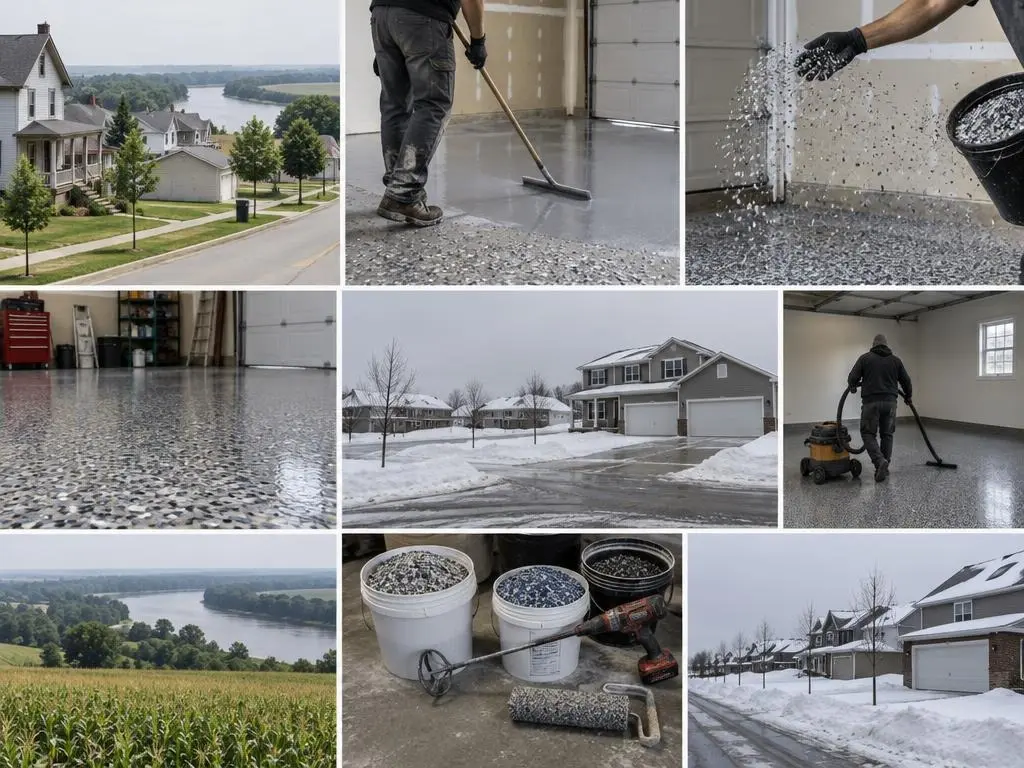
Why Homeowners Call Cedar Rapids Epoxy Flooring Pros
Slab tested before we quote
We check moisture and look at the concrete in person, so the system fits the floor you actually have.
Grinding and repair on every job
Diamond grinding opens the surface and removes weak concrete. Cracks and spalls are filled before the base coat.
Built for salt, slush and cold
Garage floors get a chemical-resistant topcoat and texture so winter meltwater stays on top and the floor is safer to walk on.
Itemized written price
Square footage, prep, each coat and the total are on paper. Changes are written up and approved before we do them.
Get an Epoxy Flooring Estimate
Free on-site estimates in Cedar Rapids and across Linn and Johnson counties.